
The Lost Computer Art of South America
Back to topThe Lost Computer Art of South America
The best-known early computer artists worked out of western Europe and the US. But there was a South American voice at the time as well—one that is less understood and mostly unknown. Our founder Michael Bogan walks through the early works of South American computer art.
Over the past year I've spent quite a bit of time digging into early South American computer art. Alongside well-known pioneers like Knowlton, Molnar, and Nake, artists from Argentina and Brazil were also creating works with mainframes in the late 1960s. These works are in many ways rarer and more precious. In contrast to the more scientific explorations of their US/European counterparts, these works were often more political—an impressive feat given the constraints of a plotter.
While names such as Berni, Vidal, and Benedit are not yet widely known in the computer art world, we hope to change that.
Let's walk through the early South American computer artists, featuring the works we've been able to track down and acquire over the past year.
Waldemar Cordeiro (1925-1973)
Brazil
Cordeiro is perhaps the best known of the South American computer artists. Born in 1925, he had been a leading figure of São Paulo's Concrete art movement for nearly two decades before he turned to the computer. In 1968 he began collaborating with the physicist Giorgio Moscati at the University of São Paulo, creating plotter works on an IBM 360/44. He died in 1973 at the early age of 47, of cancer, just as his computer work was reaching maturity.
His most famous computer piece is perhaps A Mulher que não é B.B. (The Woman Who Is Not B.B.) (1971). In the work, Cordeiro feeds the image of a distressed Vietnamese girl through image-processing routines. The result is both a digitized portrait and commentary on the Vietnam war: this woman is not Brigitte Bardot (a famous actress and the era's defining sex symbol).
One of the Cordeiro pieces we've collected, Noise (1971), is an original computer printout of the same exact A Mulher que não é B.B. image, but in mirror form. It was actually made a few months before A Mulher que não é B.B. Cordeiro was exploring what it meant for a computer to process, deconstruct, and disassemble an image.

Here is a closer look at the detail.

Noise
Waldemar Cordeiro
1971
Plotter Drawing
Cordeiro's daughter Analívia Cordeiro (b. 1954) created computer art as well (just a few years later). She is a pioneer of computer dance and her work M3x3 (1973) is one of the first ever computer-generated dance pieces.
CAyC — Buenos Aires, Argentina
If Brazil's center of gravity for computer art was Cordeiro, Argentina's was the Centro de Arte y Comunicación (CAyC).
Founded in 1968 by Jorge Glusberg, CAyC was a Buenos Aires hub for experimental, conceptual, and computer-based art. CAyC shows traveled the world, including London, New York, and Zagreb, often paired with works from the Computer Technique Group (CTG) out of Tokyo.
In fact, the South American artists credited CTG for inspiring them to use computers to create art.
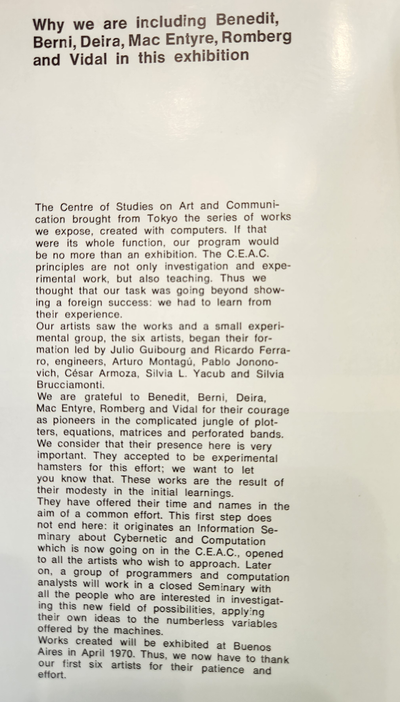
CAYC's computer-art subgroup — the Grupo de Arte y Cibernética — formed in 1969 and ran until 1973. The first Arte y Cibernética show opened at Galería Bonino, Buenos Aires, in 1969. It was the first exhibition of computer art in Latin America.
From the collection, here is the catalog for that first show, with its wrapper band still intact.

These early CAyC computer artists created plotter works using the IBM 1130 at Buenos Aires's ORT computer center. Their works rival anything coming out of the West at the time. Let's look at each of them.
Miguel Ángel Vidal (1928-2009)
Argentina
Vidal, along with Eduardo Mac Entyre, launched Arte Generativo in 1959. This was a Buenos Aires movement built on the idea that an artwork could be generated from a system of rules applied to geometric forms.
Vidal and Mac Entyre had already been making generative work by hand for ten years when the IBM 1130 at the ORT computer center in Buenos Aires became available in the late 1960s.
Vidal was a Buenos Aires native, trained as a graphic designer, who spent his career as both an artist and a teacher. He eventually served as rector of his alma mater, the Escuela Nacional de Bellas Artes Pueyrredón.
Vidal showed plotter-derived prints in Arte y Cibernética at Galería Bonino in 1969. We've been able to acquire three prints.

Untitled
Miguel Ángel Vidal
1970

Generative Structure (2)
Miguel Ángel Vidal
1969

Generative Structure
Miguel Ángel Vidal
1969
Eduardo Mac Entyre (1929–2014)
Argentina
Mac Entyre was the second co-founder of Arte Generativo. Their manifesto read, in part: "Rather than try to evade the technological age, it is far more important to engender beauty within it."
Mac Entyre is best known internationally as an op artist. His signature concentric circular fields in red, blue, and black became one of the iconic Argentine geometric idioms. What's less widely understood is how much of that work, especially from the late 1960s onward, was computer-programmed. Mac Entyre transitioned from hand-sketching to computer-generated compositions and never fully went back. His op art and his computer art are often intermingled in the same body of work.
We've acquired Untitled, a serigraph based on a plotter drawing.

Untitled
Eduardo Mac Entyre
1969
Rogelio Polesello (1939–2014)
Argentina
Polesello is best known internationally as one of Argentina's great op artists. His signature work was the acrylic lens (drilled and milled blocks of clear plastic that bent and distorted whatever sat behind them) and paintings built from the same optical results.
When Polesello joined Glusberg's Grupo de Arte y Cibernética in 1969, he brought that sensibility to the computer, treating the plotter as another instrument for producing controlled optical effects.
We've acquired Untitled (1970):

Untitled
Rogelio Polesello
1970
Antonio Berni (1905–1981)
Argentina
Berni is perhaps the most famous artist on this list. He was Argentina's great social-realist painter, winner of the 1962 Venice Biennale International Grand Prize for Engraving, internationally known for his decades-long Juanito Laguna (1958–1978) and Ramona Montiel (1962–1981) series. These were large-scale assemblage works on poverty, prostitution, and political violence in Buenos Aires, made from found garbage and industrial scrap.
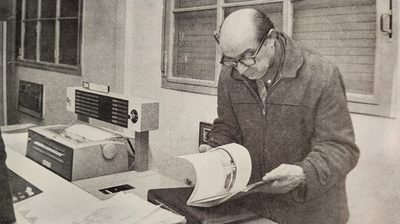
In 1969, at 64, with his social-realist reputation long established, Berni was invited to collaborate with engineers at the ORT computer center in Buenos Aires. The works were shown in Arte y Cibernética at Galería Bonino in 1969, then traveled internationally to the Computer Arts Society's Creative Computers tour of the UK (1971–72) and Tendencies 5 at the Technical Museum, Zagreb (1973).
We've acquired Untitled (1969), Berni's contribution from this brief turn to computers. A superb example of a major figurative artist passing briefly through this new medium and leaving a small body of work behind.
Remarkably, the piece fits neatly into Berni's social-realist oeuvre, even within the technical constraints of the plotter.

Untitled
Delesio Antonio Berni
1969
Luis Fernando Benedit (1937–2011)
Argentina
Benedit was an architect by training and one of Argentina's most important systems-and-nature artists. He represented Argentina at the 1970 Venice Biennale with the Biotrón: a glass-and-aluminum habitat that housed live bees. It was an early masterwork of bio-art that mapped insect behavior as a kind of organic computation.
Benedit's broader practice mapped natural systems (such as labyrinths for ants, mazes for fish, behavioral diagrams of plants and animals) through the visual language of scientific instrumentation.
His 1969 plotter prints belong to that same investigation. Benedit was also one of the six artists invited to collaborate with engineers at the ORT computer center. His works were shown in Arte y Cibernética at Galería Bonino in 1969 and entered the international tour alongside the rest of the group.
We've acquired Untitled (1969). I love that even on the plotter he's working with his bees!

Untitled
Luis Fernando Benedit
1969
Ernesto Deira (1928–1986)
Argentina
Deira is, with Berni, the other major figurative painter on this list. He was a co-founder of Otra Figuración (New Figuration) in 1961 with Rómulo Macció, Luis Felipe Noé, and Jorge de la Vega, the group that essentially defined post-informalist Argentine painting in the 1960s.
Deira's work was raw, gestural, and expressionist. Not exactly the artist anyone would expect to work with plotter geometry.
But like Berni, in 1969 Deira accepted Glusberg's invitation to work with engineers at the ORT computer center where he produced a small body of plotter drawings. The works showed at Galería Bonino in 1969 and toured with the rest of the group through Creative Computers (UK, 1971–72) and Tendencies 5 (Zagreb, 1973).
We've acquired Untitled (1970).

Untitled
Ernesto Deira
1970
José Vicente Asuar (1933–2017)
Chile
Let's move now away from CAyC and to our last country, Chile.
Jose Asuar is the founding figure of Chilean electronic music and the only South American working with computers in sound rather than images during this period. An electrical engineer and composer trained with Boris Blacher in Berlin, he founded the first electronic music studio in South America at the Universidad Católica de Chile in 1958.
In 1970 he generated the score for his work Formas I on the IBM 360 at the Universidad de Chile. The piece was the first South American work of computer-composed music. It's an orchestral work whose pitches, rhythms, and structure were determined by the computer. Formas I was premiered by the Orquesta Sinfónica de Chile on December 1, 1971.
Unfortunately, no commercial recording exists. The score is held at the Universidad de Chile.
Enrique Castro-Cid (1937–1992)
Chile/New York
As a bonus artist, let's talk about Castro-Cid.
Castro-Cid was born in Santiago and arrived in New York in 1961 on an Organization of American States grant. By the time the Buenos Aires plotter group was forming around CAyC in 1969, Castro-Cid had already been in New York for nearly a decade, building electromechanical kinetic sculptures. These were anthropomorphic robots he showed at Richard Feigen Gallery in 1965, and which Jack Burnham wrote about in Beyond Modern Sculpture (1968) as "simulations of cybernetic systems."
Castro-Cid's actual computer work came later. Working in Miami, Castro-Cid turned to computer aided design (CAD) as a transformative medium. He took classically proportioned figures and subjected them to differential geometry, conformal mapping, and multilinear perspective. The result was what one curator called a kind of "scientific cubism" in which bodies appear warped by forces that exceed the flat plane.
We've acquired several works from this period, including Latin Girls and Cow's Singularity.

Latin Girls
Enrique Castro-Cid
1979
Painting

Cow's Singularity
Enrique Castro-Cid
1988
Mixed Media
Castro-Cid's later works are still available at reasonable prices (for now) and worth seeking out.
Even with all of the above, we are still missing several important South American computer artists from our collection, including Nougués, Demarco, Robirosa, Tamburini, Romberg, Dujovny, and Mariño.
For Romberg, you can see an example in the Spalter Digital collection here.
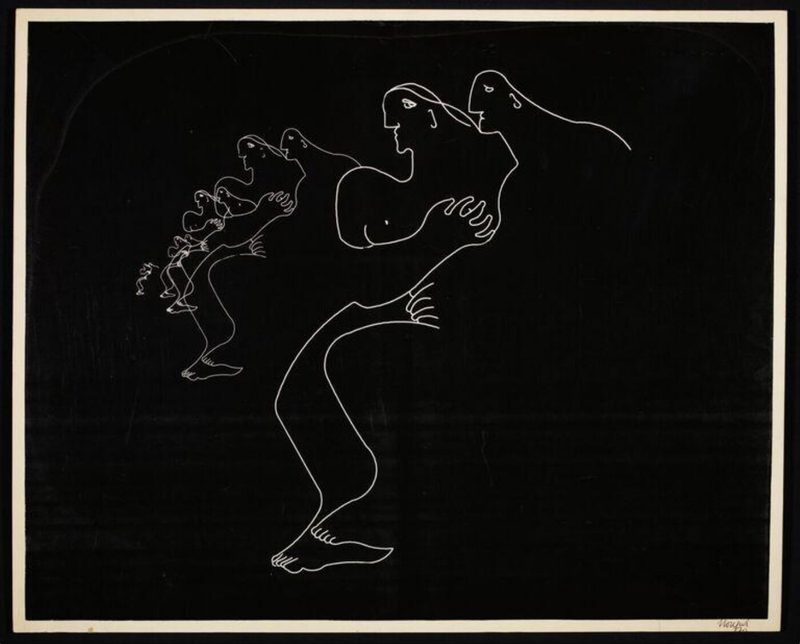
The V&A holds this beautiful Nougués work seen here:
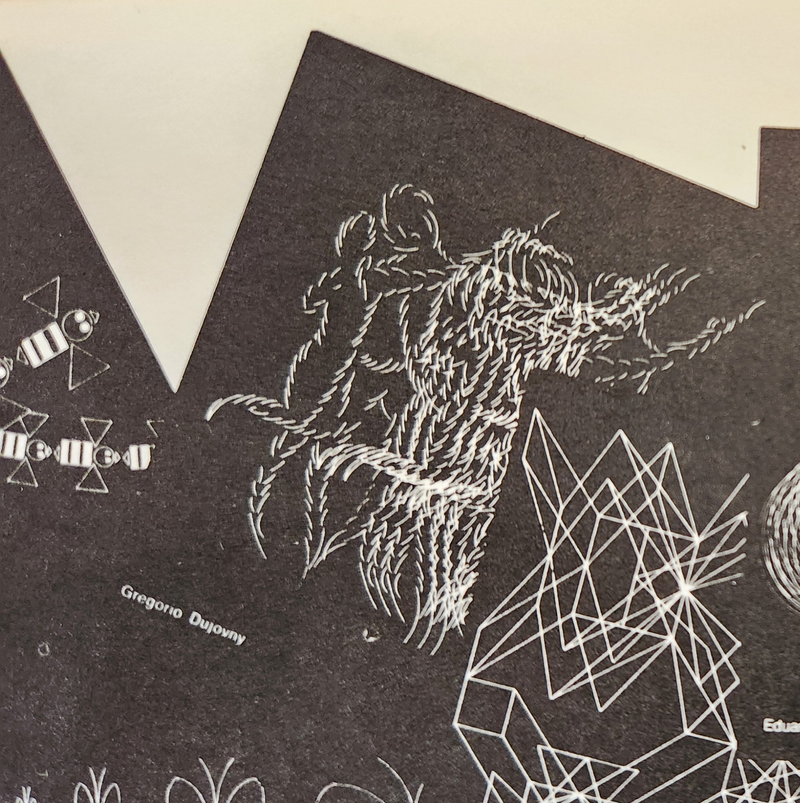
They also hold 2 Dujovny computer works, but there are no images online. In fact, I think the below photo is the first to be seen in many years of his computer works. From the back of a CAyC catalog:
An image of a Mariño computer work can be found here, but I can find no records of anyone owning this piece.

There are a few more artists I suspect created computer art at the time, but I have yet to definitively confirm or see the artworks. We're working on it and will update as needed.
A revival of the South American works
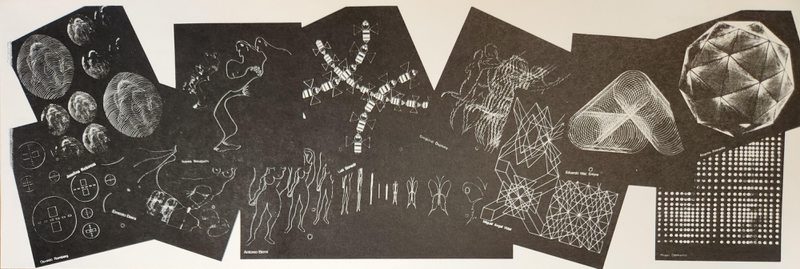
Many of the works we've talked about have sister-prints held in the Tate, V&A, or MoMA. They weren't always invisible. But what's missing is a modern revival in the broader history of computer and digital art.
Tracking these down took nearly a year of Spanish and Portuguese catalogues, estate inquiries, auctions, and conversations. Hopefully these efforts help put these names next to Knowlton, Nake, and Molnar where they belong.
Related Posts

Interdisciplinary, International: How computer art crossed borders in its first decade
How the early computer art collectives used collaborations to democratize creative practices.
Read More →
The Original Computer Art? Lissajous Figures Created with Oscilloscopes
Before artists used computers to make art, they used oscilloscopes.
Read More →