
Digital Art in the Age of Deep Learning
Back to topDigital Art in the Age of Deep Learning
Luba Elliot explores how artists have responded to evolving concepts of what artificial intelligence is and does
Starting in the 2010s, AI researchers harnessed increasing computational power to develop deep learning systems that rapidly improved their ability to recognize faces, generate recommendations, and produce images. These systems rely on layered neural networks—computational structures loosely inspired by the human brain—to identify statistical patterns across vast datasets. Billions of photographs, screenshots, scans, memes, and video stills scraped from the internet served as training material, embedding contemporary image culture directly into the operation of these models. As a result, much art made with deep learning operates in close dialogue with the visual conventions of social media, search engines, and stock photography—the same ecosystems that power generative AI and image-recognition systems.
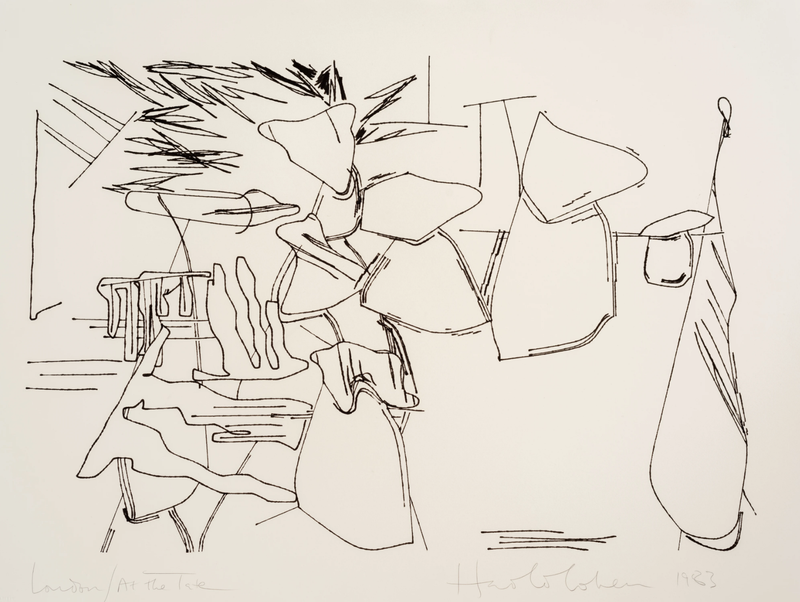
This orientation marks a decisive break from earlier artistic engagements with AI in the 1970s and 1980s, when “artificial intelligence” referred primarily to symbolic systems governed by explicit rules and logical procedures. Harold Cohen’s plotter-based system AARON, for example, was designed to autonomously generate drawings by selecting options within predefined parameters. In contrast, contemporary AI systems do not “reason” symbolically but instead infer correlations from data, producing outputs shaped less by rules than by probabilities. AI today is defined not by its capacity to follow logic, but by its ability to generalize from examples—a shift that has fundamentally reoriented both technological development and artistic inquiry.
Artists working with the first wave of deep learning tools have embraced these new possibilities, particularly as a means of probing the essence of objects and faces—what constitutes them, and how far they can be abstracted, deformed, or recomposed while remaining legible. Projects such as Tom White’s Perception Engines (2018–22) and Golan Levin and Lingdong Huang’s Ambigrammatic Figures (2021) explore ambiguity, misrecognition, and visual duality. White’s work focuses on producing the most minimal form that an image-recognition system will still classify as a specific object. Using ImageNet—a large-scale dataset that organizes images primarily as nouns—and techniques derived from adversarial research, White introduces subtle perturbations that cause classifiers to fail or behave unexpectedly. Works such as Printer (2018), Banana (2019), and Rabbit (2019) remain recognizable to human viewers, while Electric Fan (2018) does not, revealing a divergence between human visual intuition and machine classification.
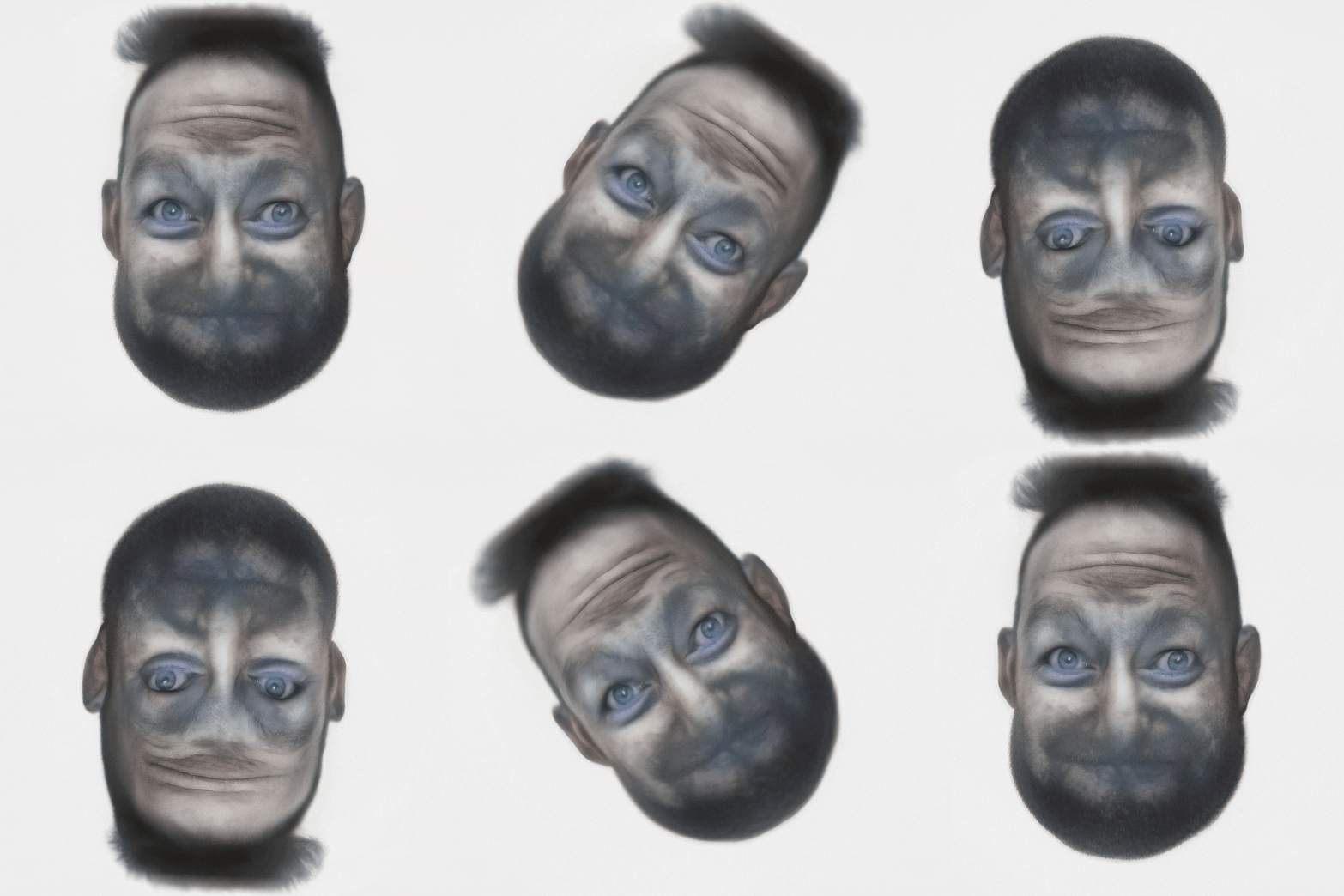
Levin and Huang’s project similarly interrogates the limits of machine vision, using a generative adversarial network (GAN) to search the latent space of facial images. GANs are a widely used image-generation system composed of two neural networks: one that generates images and another that evaluates whether those images appear “real” or “fake.” In Ambigrammatic Figures, the artists exploit this structure to produce faces that resolve differently when rotated, collapsing two identities into a single, unstable outline. In both practices, the constraints of machine vision—shaped by online image culture and dataset logic—become sites of experimentation rather than obstacles, revealing how contemporary AI art emerges directly from the statistical assumptions embedded in networked imagery of the 2010s.

Since the public release of DALL-E in 2022, text prompts have become a dominant interface for image generation. Tom White counters the expectations of this paradigm in Homage to the Pixel (2022), which asks what color—not image—might be produced by a single-word prompt such as “Cave.” The result is a tiled square of green hues with a yellow center, an austere abstraction that resists the figurative richness typically associated with generative AI imagery. By contrast, All Technique No Passion’s Elements (2022) series embraces visual excess, drawing on the psychedelic aesthetic historically associated with early deep learning art. While Elements does not use DeepDream, its use of VQGAN-CLIP operates in a similar register of fluid forms, saturated color, and hallucinatory transformation.
This aesthetic lineage is instructive. DeepDream, introduced in 2015, sparked widespread artistic interest by revealing what neural networks “see” within images—responding, in effect, to the instruction: make the existing image more like what the network thinks it contains. CLIP later introduced a way for models to evaluate semantic correspondence between images and text, answering the question: does this image match this prompt? DALL-E extends this logic by generating new images directly from language: create an image that matches the text. In Elements, the continuously morphing visuals reflect the unstable and ongoing process of judging correspondence between image and prompt—a task that can never fully resolve, given the probabilistic structure of the model itself.
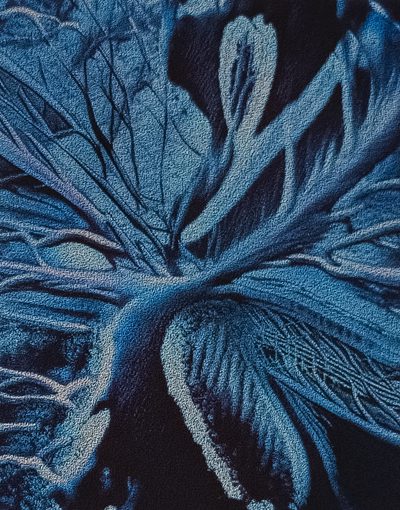
The contrast between White’s restrained abstractions and the lush, moving imagery of All Technique No Passion underscores the diversity of relationships between language and visuals made possible by contemporary AI tools: a single word may evoke a color field or conjure an entire visual universe. This shift also marks a transition from earlier GAN-based systems, which generate images by negotiating internal visual coherence, to newer models like CLIP and DALL-E, which anchor generation in linguistic meaning. Ivona Tau’s Nondescriptives #27 (2024) bridges these paradigms by using images produced by text-to-image models as training data for a GAN. By combining the semantic strengths of prompt-driven systems with the evaluative structure of GANs, Tau produces coarsely textured plant forms shaped by a dataset evenly split between organic and industrial imagery—a visual logic that mirrors the dataset’s internal composition.
Alternative modes of collaboration with AI systems—beyond the conventional pipeline of off-the-shelf tools, standardized datasets, familiar prompts, and direct minting of outputs as NFTs—emerge in practices that claim authorship over data, models, and process. Sarah Meyohas began Infinite Petals (2023–25) in 2016 by orchestrating a large-scale data collection effort at the former offices of Bell Labs, directing workers to separate rose petals and select the most beautiful for inclusion in a dataset. This dataset was later used to train a GAN that generates petals endlessly, foregrounding the human labor and aesthetic judgment embedded in training data. Meyohas has emphasized that GANs can learn deeply from relatively small, carefully curated datasets, in contrast to models like DALL-E that rely on massive, heterogeneous image corpora.
Memo Akten’s autopoiesic transmogrification fragment #001 and #003 (2022) further destabilize standard workflows by swapping datasets partway through GAN training. The resulting images combine large-scale compositional features from one dataset with fine-grained textures from another, making the internal mechanics of learning visually legible.
Orkhan Mammadov’s Rêveries series (2025) turns convolutional neural networks—typically used for recognizing and classifying images—into generative painting engines. Unlike GANs or diffusion-based text-to-image models, convolutional networks operate hierarchically, progressively transforming texture and form as information passes through successive layers. In Mammadov’s reimagining of classical scenes, dissolving colors and shifting geometric abstractions trace this layered process, visualizing how representation mutates across the network’s depth. Even as increasingly accessible AI tools dominate the present, these practices demonstrate how artists continue to return to—and repurpose—the recent history of deep learning in order to probe alternative aesthetic and technical possibilities.
Taken together, these works demonstrate the thematic, conceptual, and aesthetic breadth of art made with deep learning systems. Rather than treating AI as a neutral image engine, the artists approach it as a site of interrogation—of perception, datasets, interfaces, and technical assumptions. By working against the defaults of prompt-driven generation and emphasizing data curation, model design, and process, they assert human creative agency not in spite of automation, but through it. In doing so, they expose the generalizations embedded in training data and the aesthetic conventions that arise from them, pointing toward alternative trajectories for AI art in which critical inquiry and technical experimentation remain central.
Luba Elliott is a curator, producer and researcher specializing in artificial intelligence in the creative industries. She works to educate and engage the broader public about the latest developments in creative AI through talks, exhibitions and tech demonstrations at venues across the spectrum of art, business, and technology, including the Victoria and Albert Museum, ZKM Karlsruhe, Impakt Festival, the Leverhulme Centre for the Future of Intelligence, CogX, NeurIPS, and ICCV.
Related Posts

The Lost Computer Art of South America
Most early computer artists worked out of Europe and the US. But there was a South American voice as well—one that is less understood and mostly unknown.
Read More →
Interdisciplinary, International: How computer art crossed borders in its first decade
How the early computer art collectives used collaborations to democratize creative practices.
Read More →